Backgammon Rules
Complete guide to playing the world's oldest board game
1Board Setup
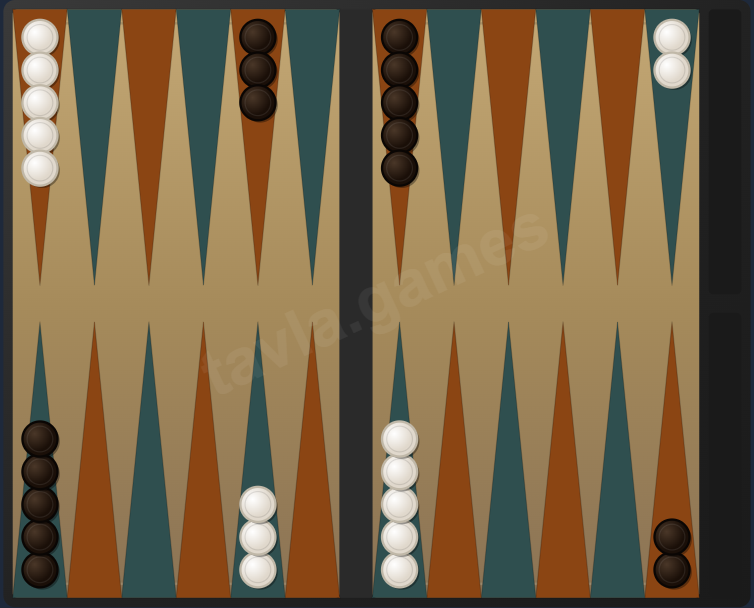
Backgammon is played on a board consisting of 24 narrow triangles called points. The points alternate in color and are grouped into four quadrants of six points each.
Each player has 15 checkers of their own color. The initial arrangement is: 2 checkers on the 24-point, 5 on the 13-point, 3 on the 8-point, and 5 on the 6-point.
Both players have their own pair of dice and a dice cup. A doubling cube with the numbers 2, 4, 8, 16, 32, and 64 is used to track stakes.
2Objective
The objective is to move all your checkers into your home board and then bear them off. The first player to remove all their checkers wins the game.
White moves counterclockwise from the upper-left toward the lower-right. Black moves in the opposite direction.
3Movement
To start, each player rolls one die. The higher number goes first, using both dice for their opening move. After that, players alternate turns, rolling two dice each time.
Movement Rules
- A checker can only move to an open point—one not occupied by two or more opposing checkers.
- The numbers on the dice are separate moves. You can move one checker the total, or two checkers separately.
- Doubles are played twice. Rolling 6-6 gives you four 6s to play.
- You must use both dice if legally possible. If only one can be played, play the higher number.
4Hitting & Entering
A point with only one checker is called a blot. If you land on an opponent's blot, that checker is hit and placed on the bar (the raised strip in the center).
A player with checkers on the bar must enter them into the opponent's home board before making any other moves. To enter, roll a number corresponding to an open point in the opponent's home board.
If neither number rolled allows entry, you lose your turn entirely!
5Bearing Off
Once all 15 of your checkers are in your home board, you can start bearing off. Roll a number matching a point with your checker, and remove it from the board.
If you roll a number higher than your highest occupied point, you must bear off from the highest occupied point. You can always move within your home board instead of bearing off.
If a checker is hit during bearing off, you must re-enter it and bring it all the way back to your home board before continuing.
6The Doubling Cube
The doubling cube adds a strategic gambling element. At the start of your turn, before rolling, you can offer to double the stakes.
Your opponent can refuse (and lose the current stake) or accept (and own the cube). Only the cube owner can offer the next double.
In casual play, the doubling cube is often not used. It's most common in tournament and money games.
7Scoring
- Single GameThe loser has borne off at least one checker. Worth 1 point (× doubling cube).
- GammonThe loser has not borne off any checkers. Worth 2 points (× doubling cube).
- BackgammonThe loser has checkers on the bar or in the winner's home board. Worth 3 points (× doubling cube).
Ready to Play?
Put your knowledge to the test against our AI or challenge a friend!